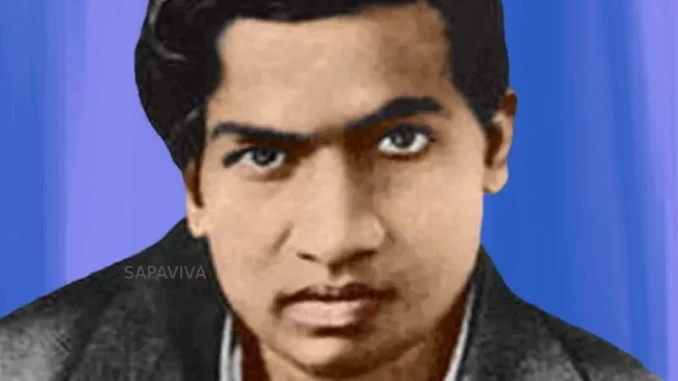
Srinivasa Ramanujan, a name synonymous with brilliance and ingenuity, was an Indian mathematician whose contributions continue to influence modern mathematics. Born in the late 19th century, Ramanujan’s work in number theory, infinite series, and continued fractions has inspired generations of mathematicians worldwide. Despite facing numerous hardships and a lack of formal training, he left behind a legacy of mathematical discoveries that continue to astonish and inspire. This biography explores the life, achievements, and enduring impact of one of the greatest mathematical minds in history.
Srinivasa Ramanujan Profile Summary
| Profile Attribute | Details |
|---|---|
| Full Name | Srinivasa Ramanujan Iyengar |
| Date of Birth | December 22, 1887 |
| Place of Birth | Erode, Tamil Nadu, India |
| Date of Death | April 26, 1920 |
| Age at Death | 32 years |
| Nationality | Indian |
| Occupation | Mathematician |
| Education | Largely self-taught; used G.S. Carr’s book A Synopsis of Elementary Results in Pure and Applied Mathematics; briefly attended local colleges |
| Field of Work | Number theory, infinite series, continued fractions, modular forms, partitions |
| Notable Achievements | Developed groundbreaking formulas for π, made advances in partition functions, contributed to modular forms and continued fractions |
| Collaborators | G.H. Hardy (Cambridge University) |
| Famous Works / Notebooks | Ramanujan Notebooks, published papers on number theory and infinite series |
| Awards / Honors | Posthumous recognition worldwide, Ramanujan Journal named in his honor, inspired films and documentaries |
| Legacy | Considered one of the greatest mathematical geniuses; continues to inspire research in number theory and modern mathematics |
Early Life and Background
Srinivasa Ramanujan was born on December 22, 1887, in Erode, India, in the southern state of Tamil Nadu. He was the first of several children in a middle-class Tamil Brahmin family. His father, K. Srinivasa Iyengar, was a clerk in a cloth shop, and his mother, Komalatammal, was a deeply religious woman who encouraged her son’s early fascination with mathematics.
From a young age, Ramanujan displayed extraordinary talent in numbers. By the age of 11, he had mastered trigonometry and algebra, often solving complex problems mentally. His notebooks from this period already contain formulas and results that formed the foundation of his groundbreaking work.
Despite his innate talent, Ramanujan faced difficulties in formal schooling. He struggled with subjects outside mathematics, especially English, and this created tension in his academic progress. However, his fascination with numbers never waned, and he spent countless hours exploring mathematics independently.
Education and Early Mathematical Discoveries
Ramanujan’s formal education was sporadic and challenging. He attended local schools but often found the curriculum uninspiring. At age 15, he discovered G.S. Carr’s “A Synopsis of Elementary Results in Pure and Applied Mathematics”, a book compiling thousands of mathematical formulas. This book became his primary guide, and through it, Ramanujan taught himself advanced mathematics.
During this period, he began developing his own theorems and mathematical ideas, many of which were recorded in personal notebooks. These notebooks later became legendary in the mathematics community because they contained results that were highly unconventional, original, and often correct, despite lacking formal proofs.
Career and Mathematical Contributions
Ramanujan’s early work in India caught the attention of local mathematicians, but it was his correspondence with G.H. Hardy, a renowned mathematician at Cambridge University, that changed the trajectory of his life. In 1913, Ramanujan sent a letter to Hardy containing several theorems, some of which were highly unconventional and groundbreaking. Hardy immediately recognized Ramanujan’s genius and invited him to Cambridge.
At Cambridge, Ramanujan flourished, producing groundbreaking work in multiple areas of mathematics:
- Infinite Series: He developed new formulas for π (pi) that were far more efficient than any previously known.
- Continued Fractions: His work on continued fractions remains highly influential in modern number theory.
- Modular Forms and Partition Functions: He formulated advanced mathematical results that would later play a crucial role in modern mathematics, including in string theory and combinatorics.
Ramanujan’s approach to mathematics was deeply intuitive. Unlike many mathematicians, he often relied on insights rather than formal proofs, which led to both admiration and skepticism among his peers. Despite this, the accuracy and originality of his results were undeniable.
Life in England
Ramanujan arrived in England in 1914, at the age of 26. Life in Cambridge presented both opportunities and challenges. He had to adapt to a cold climate, unfamiliar cuisine, and cultural differences while maintaining his health and continuing his mathematical work.
During his time in England, Ramanujan collaborated closely with G.H. Hardy, producing several joint papers that are now considered fundamental in number theory. Hardy described him as “the most remarkable mathematician I have ever known,” emphasizing Ramanujan’s originality and depth.
World War I brought additional challenges, including rationing and restricted resources, but Ramanujan continued to develop new mathematical ideas. He published some of his most important papers during this period, cementing his reputation as a genius.
Srinivasa Ramanujan Spouse
Srinivasa Ramanujan was married to Janaki Ammal in 1909, following traditional customs common in India at the time. Janaki Ammal was much younger than Ramanujan when they married, and their marriage was arranged by their families.
For much of their married life, the couple lived apart due to Ramanujan’s studies and his travel to England. Janaki Ammal remained in India while Ramanujan studied and worked at Cambridge University. After his return to India in 1919, they lived together until his death in 1920.
Srinivasa Ramanujan’s Children
Srinivasa Ramanujan did not have any children. Historical records and biographical accounts consistently confirm that he left no descendants.
After Srinivasa Ramanujan’s death in 1920, Janaki Ammal lived a long life and played an important role in preserving his legacy. She later adopted a young boy, W. Narayanan, in 1950, raising him as her own son and providing for his education.
She ensured that Ramanujan manuscripts and notebooks were protected and made available to scholars. She passed away in 1994, decades after Ramanujan’s death.
Ramanujan Health Challenges
Unfortunately, Ramanujan’s health began to decline while he was in England. The cold climate and dietary restrictions affected him, and he suffered from multiple illnesses. In 1919, he returned to India in hopes of recuperating, but his condition worsened.
Despite his declining health, Ramanujan continued to work on mathematics until the end of his life. He died on April 26, 1920, in Kumbakonam, India, at the young age of 32. His death was a profound loss to the mathematical world, but his notebooks and published papers continued to inspire researchers for decades.
Srinivasa Ramanujan Legacy
Srinivasa Ramanujan’s legacy is immense. He is celebrated as a mathematical genius who overcame poverty, illness, and lack of formal education to produce work of lasting significance. His contributions have influenced number theory, combinatorics, and even modern physics.
In recognition of his achievements:
- The Ramanujan Journal publishes research inspired by his work.
- The Srinivasa Ramanujan International Centre for Mathematics in India promotes mathematical research.
- He has been the subject of books, films, and documentaries, including the acclaimed film The Man Who Knew Infinity (2015).
Ramanujan’s story continues to inspire mathematicians and students worldwide, highlighting the power of curiosity, perseverance, and natural talent.
Frequently Asked Questions About Srinivasa Ramanujan
- What was Srinivasa Ramanujan famous for?
He was famous for his groundbreaking contributions to number theory, infinite series, continued fractions, and modular forms. - When was Ramanujan born and when did he die?
Born on December 22, 1887, and died on April 26, 1920. - Did Ramanujan have formal education in mathematics?
He was largely self-taught, using books and independent study rather than formal training. - Who was G.H. Hardy, and what was his role in Ramanujan’s life?
Hardy was a renowned British mathematician who recognized Ramanujan’s genius, collaborated with him at Cambridge, and helped bring his work to international attention. - What are Ramanujan’s most notable contributions to mathematics?
His most notable contributions include formulas for π, discoveries in partition functions, modular forms, and infinite series that remain influential today.
Conclusion
Srinivasa Ramanujan remains one of the most remarkable figures in mathematics. His life exemplifies how passion, intuition, and dedication can overcome limitations and leave a lasting impact on the world. From a small town in India to the halls of Cambridge University, Ramanujan’s journey continues to inspire mathematicians, scholars, and curious minds globally. His story is a timeless reminder that true genius often comes from resilience, self-belief, and an unquenchable thirst for knowledge.
Read more:
- Jourdin Pauline Biography: Life, Age, Career And Songs
- Angie Motshekga Biography: Life, Politics, Career and Military
Be the first to comment