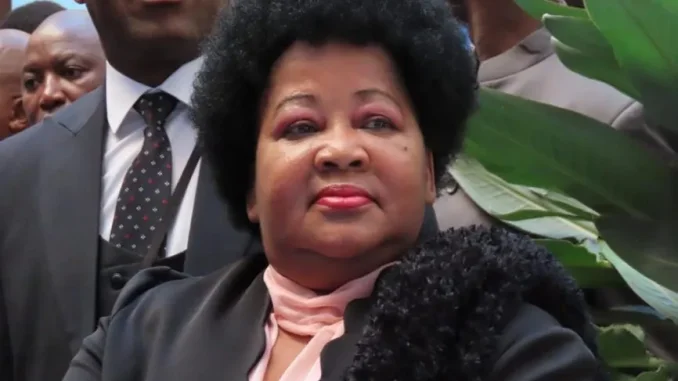
Dikeledi Magadzi was a respected South African political leader, liberation struggle veteran, and Politician whose career spanned the transition from apartheid to democratic governance. She emerged from grassroots activism within the African National Congress (ANC) and went on to serve in senior provincial and national government roles, including as a Member of the Executive Council (MEC) in Limpopo, a Member of Parliament, and a Deputy Minister in two key national portfolios.
Known for her organisational discipline and long-standing commitment to the ANC, Magadzi played an influential role in both party structures and state institutions. Her decades of service placed her among the generation of leaders who helped shape post-apartheid governance in South Africa, particularly in areas of infrastructure, transport, agriculture, and water and sanitation. She remained an important political figure until her departure from Parliament in 2023 and her passing on 28 December 2025.
Dikeledi Magadzi Profile Summary
| Profile Item | Details |
|---|---|
| Full Name | Dikeledi Phillistus Magadzi |
| Nationality | South African |
| Political Party | African National Congress (ANC) |
| Year of Birth | 1949–1950 |
| Age at Death | 75 |
| Date of Death | 28 December 2025 |
| Political Background | Anti-apartheid activist; veteran of mass democratic movements |
| Provincial Roles | MEC for Public Works (1994–1998); MEC for Agriculture (2004–2009); MEC for Safety and Security (2009–2010) |
| Parliamentary Service | Member of the National Assembly (2014–2023) |
| Parliamentary Leadership | Chairperson, Portfolio Committee on Transport (2014–2019) |
| Deputy Ministerial Roles | Deputy Minister of Transport (2019–2021); Deputy Minister of Water and Sanitation (2021–2023) |
| ANC Leadership | Member of the ANC National Executive Committee (2007–2022) |
| Family Life | Married; mother of five children; grandmother |
| Public Reputation | Disciplined ANC cadre; experienced administrator; long-serving public servant |
| Wikipedia | https://en.wikipedia.org/wiki/Dikeledi_Magadzi |
Dikeledi Magadzi Early Life and Activism
Dikeledi Magadzi emerged as a political activist during the height of South Africa’s anti-apartheid struggle, aligning herself with mass democratic movements that opposed racial segregation and authoritarian rule. Her early political development was rooted in community-based organising, labour activism, and women’s mobilisation, which together formed the foundation of her later leadership roles.
She was actively involved in the United Democratic Front (UDF), a broad coalition that united civic organisations, churches, trade unions, and political activists against apartheid in the 1980s. Through the UDF, Magadzi participated in grassroots resistance efforts that emphasised popular participation, political education, and collective action.
Magadzi also played a role within the organised labour movement as a member of the National Education, Health and Allied Workers’ Union (NEHAWU), where she engaged with issues affecting workers in the public sector, particularly in education and health services.
In addition, she was active in women’s political structures, including the Federation of South African Women and the ANC Women’s League, serving on the Women’s League executive committee from 1990 to 1996. Her work in these Organizations focused on advancing women’s political participation and integrating gender concerns into the broader liberation agenda.
Collectively, Magadzi’s involvement in these organizations established her reputation as a disciplined and committed grassroots activist, positioning her for leadership roles in the post-apartheid government and within the African National Congress.
Dikeledi Magadzi Political Career
Dikeledi Magadzi played a significant role in provincial governance in Limpopo, where she held several senior executive positions during the formative years of South Africa’s democratic administration. Her work at provincial level placed her among the key political leaders responsible for translating post-apartheid policy into practical governance.
She first served as Member of the Executive Council (MEC) for Public Works from 1994 to 1998, a period marked by the urgent need to rebuild and expand public infrastructure after decades of apartheid neglect. In this role, she oversaw government facilities, infrastructure development, and maintenance programmes that supported the establishment of a functional provincial administration.
Magadzi later returned to the Organization as MEC for Agriculture between 2004 and 2009, where she was responsible for agricultural development, food security initiatives, and support for rural communities. Her tenure coincided with efforts to strengthen subsistence and commercial farming, land reform support, and agricultural services in one of South Africa’s most rural provinces.
From 2009 to 2010, she served as MEC for Safety and Security, overseeing provincial coordination on crime prevention, community safety, and cooperation with national policing structures. This portfolio placed her at the intersection of governance, law enforcement, and community stability.
Collectively, these roles positioned Magadzi at the centre of Limpopo’s provincial administration, giving her extensive executive experience across infrastructure development, agriculture, and public safety, experience that later informed her work at national level.
Dikeledi Magadzi National Parliament and Leadership
Dikeledi Magadzi entered the national legislature following her election to the National Assembly of South Africa in May 2014, where she served until March 2023. Her time in Parliament marked a transition from provincial executive authority to national legislative oversight, placing her within the core lawmaking and accountability structures of the South African state.
Shortly after her election, she was appointed Chairperson of the Portfolio Committee on Transport, a position she held from 2014 to 2019. In this role, Magadzi led parliamentary oversight of the transport sector, including roads, rail, aviation, maritime affairs, and state-owned transport entities. She presided over committee deliberations on transport legislation, budget overseeing, policy implementation, and the accountability of the Department of Transport and its agencies.
Her leadership of the committee was characterised by firm procedural control and a focus on infrastructure development, service delivery, and governance within South Africa’s transport system. The role further elevated her national profile and laid the groundwork for her subsequent appointment to the executive as Deputy Minister.
Dikeledi Magadzi Deputy Ministerial Roles
Dikeledi Magadzi advanced to the national executive following the 2019 general elections, where she was appointed to two successive deputy ministerial positions that placed her within the core of South Africa’s infrastructure and service-delivery apparatus.
She was appointed Deputy Minister of Transport on 30 May 2019, serving until 5 August 2021 under President Cyril Ramaphosa. In this role, Magadzi supported the political and administrative leadership of the transport sector, which includes roads, rail, aviation, maritime transport, and public transport systems. Her responsibilities involved parliamentary liaison, policy support, and oversight of state-owned entities within the transport portfolio.
On 5 August 2021, she was reassigned as Deputy Minister of Water and Sanitation, a position she held until 6 March 2023. This portfolio placed her at the centre of one of South Africa’s most critical development challenges: ensuring sustainable access to water resources and sanitation services. Her work supported national efforts related to water infrastructure development, service delivery, and institutional governance within the sector.
Across both appointments, Magadzi contributed to executive leadership in departments fundamental to economic development, public welfare, and infrastructure sustainability, reinforcing her status as an experienced and trusted figure within the ANC-led government.
Dikeledi Magadzi ANC Leadership and NEC Involvement
Dikeledi Magadzi was a longstanding and influential figure within the African National Congress, where she served on the party’s National Executive Committee (NEC) from 2007 to 2022. The NEC is the ANC’s highest decision-making body between national conferences, responsible for guiding political strategy, organisational discipline, and policy direction.
Her fifteen-year tenure on the NEC reflected her standing within the party as a seasoned cadre with deep roots in the liberation movement and extensive experience in government. During this period, she contributed to internal party processes related to leadership development, organisational cohesion, and political education, while also representing the perspectives of provincial and grassroots structures.
At the ANC’s 55th National Conference in December 2022, Magadzi stood for re-election to the NEC but was unsuccessful. This outcome marked the end of her formal leadership role within the party’s top structure and preceded her subsequent departure from the national executive and Parliament in 2023.
Her NEC service remains one of the defining aspects of her political legacy, underscoring her long-term influence within the ANC and her role in shaping the party during the post-apartheid era.
Dikeledi Magadzi Resignation from Parliament
Following the 2023 cabinet reshuffle, Dikeledi Magadzi was replaced as Deputy Minister of Water and Sanitation, bringing her tenure in the national executive to an end. Shortly thereafter, she resigned from the National Assembly of South Africa on 15 March 2023, formally concluding her parliamentary career.
Her resignation marked the close of nearly a decade of service in the national legislature, during which she held senior leadership roles in Parliament and served in two deputy ministerial portfolios. The move was widely understood as her withdrawal from frontline national politics after many years of sustained public service at both provincial and national levels.
Dikeledi Magadzi Personal and Family Life
Dikeledi Magadzi maintained a relatively private personal life, even while occupying senior positions in government and within the African National Congress. She was married and was a mother of five children, and she is also known to have had at least two grandchildren.
Despite the demands of a long and intensive political career, Magadzi was regarded by colleagues as someone who balanced public service with strong family commitments. She did not frequently speak publicly about her family, choosing instead to keep her private life largely out of the political spotlight. This discretion contributed to her reputation as a disciplined and focused public servant whose public identity was closely tied to her work in the liberation movement, government, and party structures rather than personal publicity.
Dikeledi Magadzi Death and Legacy
Dikeledi Magadzi passed away on 28 December 2025 at the age of 75. Her death was formally announced and mourned by the African National Congress, which paid tribute to her long-standing service and described her as a leader defined by discipline, commitment, and dedication to public service and the liberation movement.
Tributes from within the ANC and government structures highlighted her decades of contribution to South Africa’s political life, spanning the struggle against apartheid, provincial governance in Limpopo, national parliamentary leadership, and executive responsibility as a deputy minister. Her career reflected continuity between the liberation movement and the post-apartheid state, marking her as part of a generation that helped shape democratic governance in South Africa.
Magadzi is remembered as a seasoned ANC cadre, a respected provincial and national leader, and a politician who operated across multiple levels of government. Her legacy is closely associated with institutional discipline, organisational loyalty, and sustained service to the ANC and the South African state.
Conclusion
Dikeledi Magadzi leaves behind a political legacy defined by continuity, discipline, and long-term service to South Africa’s liberation movement and democratic state. From grassroots activism during apartheid to senior leadership roles in provincial and national government, her career reflected a steady progression rooted in organisational loyalty and public duty.
Across decades, she operated at multiple levels of governance shaping policy, exercising oversight, and contributing to executive leadership in key sectors critical to national development. Her work within the African National Congress and the state positioned her among the generation of leaders who bridged the struggle era and post-apartheid governance.
Magadzi’s life in public service stands as a record of sustained commitment rather than personal prominence. She is remembered as a disciplined ANC cadre, an experienced administrator, and a figure whose contributions formed part of the institutional fabric of South Africa’s democratic journey.
Frequently Searched Questions About Dikeledi Magadzi
1. Who was dikeledi magadzi husband?
Dikeledi Magadzi was married, but details about her husband’s identity were kept private.
2. What is dikeledi magadzi place of birth?
Her place of birth is at Coptic Hospital in Nairobi. She was South African by nationality and spent much of her political life working in Limpopo Province.
3. What was dikeledi magadzi age?
Dikeledi Magadzi was born around 1949–1950 and was 75 years old at the time of her death on 28 December 2025.
4. What was dikeledi magadzi cause of death?
She passed on after a brief illness, official cause of death was not publicly disclosed. Public statements focused on honoring her life and service rather than medical details.
5. When did dikeledi magadzi passed away?
Dikeledi Magadzi passed away on 28 December 2025 in South Africa.
6. When did dikeledi magadzi died?
She died on 28 December 2025, as confirmed by ANC leadership and national reports.
7. What is known about dikeledi magadzi death?
Her death was formally announced by the African National Congress, which described her as a disciplined cadre and veteran of the liberation struggle.
8. What deputy ministerial positions did she hold?
She served as Deputy Minister of Transport from 2019 to 2021 and as Deputy Minister of Water and Sanitation from 2021 to 2023.
Read more:
- Winky D Biography: Life, Music, Awards and Legacy
- Jim Guzman Biography: Life, Wife, Age and Marriage
Be the first to comment