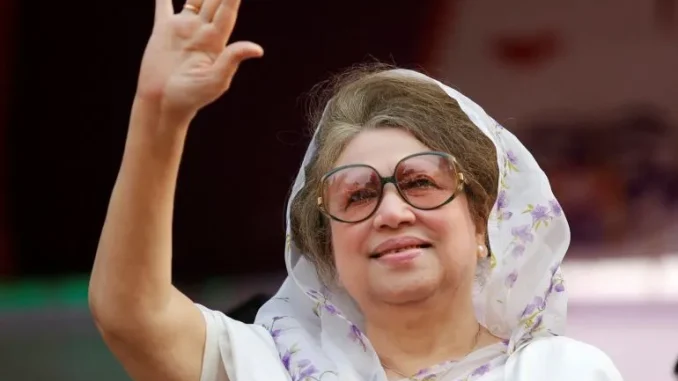
Khaleda Zia was Bangladesh’s first female Prime Minister, she emerged as a central architect of the post-military democratic order and dominated national politics for more than three decades. Serving two terms in office and leading the Bangladesh Nationalist Party (BNP), she helped entrench a competitive two-party system while commanding popular support and exercising decisive influence over the political direction of the state.
Her rise to power was rooted in personal tragedy rather than early political ambition. Following the assassination of her husband, President Ziaur Rahman, in 1981, Khaleda Zia moved from private life into the political arena, gradually transforming into a formidable leader. Over time, she consolidated control of the BNP, mobilized mass movements, and positioned herself as one of the two dominant political forces in the country. Her career unfolded in parallel with a long and bitter rivalry with Sheikh Hasina, a confrontation that shaped governance, elections, and political culture for decades and came to be known as the “Battle of the Begums.”
Khaleda Zia’s legacy remains complex and deeply contested. Supporters credit her with restoring parliamentary democracy and advancing women’s leadership in a traditionally male-dominated political landscape, while critics emphasize governance failures, political instability, and corruption convictions that marked her later years. Her prolonged illness, imprisonment, and death on 30th december 2025 underscored both the personal cost of her political life and her enduring significance. Ultimately, she stands as a defining figure of an era one whose impact on Bangladesh’s democracy and political identity continues to shape historical and public debate.
Khaleda Zia Profile Summary
| Field | Details |
|---|---|
| Full Name | Khaleda Zia |
| Honorific | Begum Khaleda Zia |
| Date of Birth | 15 August 1945 |
| Place of Birth | Dinajpur, Bangladesh |
| Nationality | Bangladeshi |
| Political Party | Bangladesh Nationalist Party (BNP) |
| Position Held | Prime Minister of Bangladesh |
| Terms in Office | 1991–1996; 2001–2006 |
| Notable Distinction | First female Prime Minister of Bangladesh |
| Spouse | Ziaur Rahman (President of Bangladesh, assassinated in 1981) |
| Children | Tarique Rahman; Arafat Rahman (Koko, deceased) |
| Education | Public sources report schooling in Dinajpur and attendance at Surendranath College |
| Political Entry | Entered politics after her husband’s assassination in 1981 |
| Major Achievements | Restoration of parliamentary democracy (1991); leadership of two-party political system |
| Key Rival | Sheikh Hasina |
| Legal Issues | Convicted in corruption cases in 2018; later released under medical and legal conditions |
| Health | Suffered from chronic liver disease, diabetes, and heart complications |
| Date of Death | 30 December 2025 |
| https://www.facebook.com/khaleda.zia/ |
Khaleda Zia Early Life and Childhood
Khaleda Zia was born in the mid-1940s, a period of profound political transition in the Indian subcontinent. Her date of birth is 15 August 1945 in Dinajpur, in present-day northern Bangladesh, with the family relocating to Dinajpur following the Partition of British India in 1947. Regardless of birthplace, Dinajpur is consistently recognized as the setting of her formative years and early education, and it is commonly treated as her hometown.
Khaleda Zia was born into a middle-class Bengali Muslim family. Her father, Iskandar (Iskandar Ali) Majumder, is generally described as a businessman, and her mother was Taiyaba Majumder. The family’s ancestral roots was Feni District, though her upbringing and schooling are most firmly associated with Dinajpur. Her childhood is widely portrayed as conventional and largely insulated from political activism, shaped instead by family life and the social norms of post-partition East Bengal.
In 1960, she married Ziaur Rahman, then a military officer, and thereafter devoted herself primarily to domestic responsibilities as a wife and mother. Her early adult life remained outside the public sphere, even during periods of national crisis. The Bangladesh Liberation War of 1971, during which her husband played an active role, was a formative personal experience marked by uncertainty and hardship. By the late 1970s, Khaleda Zia was still a private individual, and it was only after Ziaur Rahman’s assassination in 1981 that her life took a decisive turn toward national political leadership.
Khaleda Zia Educational Background
Khaleda Zia completed her primary and secondary education in Dinajpur, where her family was based during her formative years. She is widely reported to have attended local schools, including a girls’ high school in the district, receiving a standard middle-class education typical of East Bengal in the 1950s, She later attended Surendranath College in Dinajpur.
During her years in power, Khaleda Zia’s education became a subject of political debate, with critics questioning her academic credentials and supporters dismissing such scrutiny as politically motivated. These controversies had no constitutional bearing on her leadership, as formal higher education is not a requirement for holding executive office in Bangladesh. In historical perspective, her education is not viewed as a defining element of her political authority; rather, her leadership emerged from circumstance, political inheritance, and mass mobilization, underscoring an unconventional path to power that began far from academic or student political circles.
Khaleda Zia Marriage and Family Life
The marriage and family life of Khaleda Zia were foundational to both her personal identity and her later political emergence. Married in 1960 to Ziaur Rahman, then a young military officer, she spent much of her early adulthood outside public view. Her life during this period was defined by domestic responsibilities, frequent relocations, and long separations caused by her husband’s military duties, positioning her firmly within the private sphere rather than public or political life.
National upheaval profoundly shaped her family experience. During the Bangladesh Liberation War of 1971, while Ziaur Rahman played a prominent role in the independence struggle, Khaleda Zia and her children reportedly endured prolonged uncertainty and hardship. Even after independence and Ziaur Rahman’s rapid rise to the presidency, she maintained a restrained public profile. As a mother of two sons Tarique Rahman, who later became a senior BNP leader, and Arafat Rahman (Koko), who died in 2015 her family role remained central to how she was publicly perceived, particularly in narratives emphasizing endurance and personal sacrifice.
The assassination of Ziaur Rahman in 1981 marked a decisive turning point in her life. Suddenly widowed, Khaleda Zia was thrust into national prominence and emerged as the symbolic custodian of her husband’s political legacy. This transition from private life to public leadership was gradual rather than automatic, shaped by public sympathy, party encouragement, and political necessity. Ultimately, her marriage and family circumstances were not incidental to her rise; they provided the moral authority, legitimacy, and emotional resonance that underpinned her ascent within the Bangladesh Nationalist Party and her later dominance of national politics.
Khaleda Zia Entry into Politics
The entry of Khaleda Zia into politics was driven not by long-standing ideological activism, but by personal tragedy and political necessity. Her political life began after the assassination of her husband, President Ziaur Rahman, in May 1981, an event that abruptly ended his rule and created a leadership vacuum within the Bangladesh Nationalist Party (BNP). This moment fundamentally altered her life, drawing her from private family roles into the center of national attention.
In the immediate aftermath of Ziaur Rahman’s death, the BNP struggled to maintain cohesion and direction. Khaleda Zia, though previously detached from politics, emerged as a symbolic figure for party loyalists and supporters who sought continuity with her husband’s legacy. Initially hesitant, she did not assume formal leadership at once, but senior party figures increasingly viewed her as a unifying presence capable of stabilizing the party during a period of uncertainty.
Her political involvement developed gradually. Khaleda Zia began attending party meetings, addressing supporters, and appearing at political gatherings steps that marked a decisive break from her earlier private life. Despite having no prior experience in legislative or party organization, she quickly attracted large crowds. Her authority in this early phase rested less on political training than on moral legitimacy, public sympathy, and the symbolic weight of widowhood.
By 1984, Khaleda Zia had consolidated her position and was formally appointed Chairperson of the Bangladesh Nationalist Party, placing her at the forefront of opposition politics. Under her leadership, the BNP became a central force in movements against military-backed rule, particularly during the regime of Hussain Muhammad Ershad. By the late 1980s, she had fully transformed from a reluctant political figure into a powerful opposition leader in her own right, setting the stage for her eventual rise to the office of Prime Minister.
Khaleda Zia as Prime Minister of Bangladesh (First Term: 1991–1996)
The first term of Khaleda Zia as Prime Minister (1991–1996) marked a decisive turning point in Bangladesh’s political history. Coming to office after years of military and quasi-military rule, her government presided over the restoration of democratic governance following the fall of the Ershad regime. Her election in 1991, which made her the first woman to lead the country, was widely viewed as the culmination of a mass pro-democracy movement demanding civilian rule and constitutional order.
The most enduring achievement of her first administration was the restoration of the parliamentary system through the Twelfth Amendment to the Constitution. This reform shifted Bangladesh away from a presidential model toward parliamentary democracy, reducing the concentration of executive power and strengthening the role of parliament. The amendment is broadly regarded as a foundational milestone in the country’s modern democratic framework and remains one of the central legacies of her tenure.
Alongside constitutional reform, her government pursued policies aimed at economic stabilization, private-sector growth, expansion of education and social services, and rural infrastructure development. However, the period was also marked by intense political polarization, parliamentary boycotts, and frequent street protests, particularly involving the opposition Awami League. Disputes over electoral credibility and demands for a neutral caretaker government escalated toward the mid-1990s, ultimately bringing her first term to an end in 1996. Despite these challenges, the period firmly established Khaleda Zia as a governing authority and a central figure in Bangladesh’s democratic era.
Khaleda Zia as Prime Minister of Bangladesh (Second Term: 2001–2006)
The second term of Khaleda Zia as Prime Minister (2001–2006) began with a decisive electoral victory that returned the Bangladesh Nationalist Party (BNP) to power at the head of a broad coalition government. Unlike her first tenure, which was defined by democratic transition and constitutional reform, this period was characterized by heightened political polarization and a more contentious governing environment. Her return reflected voter dissatisfaction with the previous administration and reaffirmed her position as one of the two dominant figures in Bangladesh’s entrenched two-party system.
Her government prioritized economic growth through market-oriented policies, infrastructure expansion, and development of the energy and telecommunications sectors, while also seeking to strengthen regional and international relationships. Supporters credited the administration with maintaining economic momentum and pursuing development initiatives, but critics questioned the inclusiveness and sustainability of these gains. At the same time, the period was overshadowed by serious security challenges, most notably the rise of militant extremism. The nationwide bomb attacks in 2005 marked a critical moment, prompting large-scale counterterrorism operations that the government portrayed as decisive, even as opponents accused it of initial complacency and politicized responses.
Politically, the second term was marked by escalating confrontation with the opposition, particularly the Awami League. Parliamentary boycotts, frequent street protests, and allegations of corruption and institutional politicization intensified, contributing to a climate of instability. Public scrutiny of the role of her elder son, Tarique Rahman, in party affairs further complicated governance and public perception. As the term neared its end in 2006, disputes over electoral administration and demands for a neutral caretaker government triggered widespread unrest, leading to a state of emergency and the premature collapse of the political process. This period remains one of the most contested phases of Khaleda Zia’s career, reinforcing both her reputation for strong leadership and the enduring controversies that surrounded her rule.
Khaleda Zia Political Rivalry and the “Battle of the Begums”
The political rivalry between Khaleda Zia and Sheikh Hasina stands as one of the most enduring and consequential confrontations in South Asian politics. Often referred to as the “Battle of the Begums,” this decades-long struggle profoundly shaped Bangladesh’s political culture, governance, and public discourse. Rooted in both personal history and inherited political legacies, the rivalry reflected competing visions of nationalism and authority, with each leader symbolizing a distinct interpretation of the country’s past and future.
From the early 1990s onward, Bangladesh experienced a recurring cycle of alternating governments led by the two rivals. Each transfer of power was frequently accompanied by boycotts, mass protests, and street agitation organized by the opposition, creating persistent political instability. Parliamentary cooperation weakened as politics became increasingly confrontational, with disputes more often resolved through public mobilization than institutional dialogue. This pattern entrenched a zero-sum political environment in which compromise was rare and governance was continually contested.
Over time, the rivalry moved beyond policy differences and became deeply personalized, shaped by family legacies, historical grievances, and emotionally charged rhetoric. While intense competition helped sustain electoral participation and political engagement, the resulting polarization undermined parliamentary effectiveness, eroded public trust in institutions, and normalized political disruption. As a result, the “Battle of the Begums” came to define an entire era of Bangladeshi politics one marked by strong leadership and mass mobilization, but also by deep divisions whose effects continue to influence the country’s political landscape long after Khaleda Zia’s active role had ended.
Khaleda Zia Legal Challenges and Controversies
The later decades of Khaleda Zia’s political career were dominated by legal challenges that fundamentally altered her role in Bangladesh’s public life. After losing power in 2006, she faced multiple corruption cases, most notably those involving the Zia Orphanage Trust and Zia Charitable Trust. These cases emerged during periods when rival political forces were in government, fueling a sustained national debate over whether the prosecutions represented genuine accountability efforts or politically motivated attempts to sideline a major opposition leader.
In 2018, Khaleda Zia was convicted in a key corruption case and sentenced to prison, a development that effectively removed her from electoral politics and curtailed her direct leadership of the Bangladesh Nationalist Party (BNP). Her imprisonment attracted international attention, particularly due to her age and declining health, and raised concerns among human rights groups. Although the courts upheld the conviction at the time, the legal process unfolded within a deeply polarized political environment, ensuring that the verdict remained a subject of intense controversy rather than consensus.
As her health deteriorated, Khaleda Zia was later released under conditional arrangements akin to house arrest, with strict limits on her movement and political activity. Subsequent legal reviews and partial relief altered aspects of her legal status but did not restore her to active political leadership. The cumulative effect of these legal battles was decisive: they ended her frontline political career, weakened the BNP’s organizational continuity, and transformed her from an active power broker into a symbolic figure. Historically, these controversies stand as one of the most contested elements of her legacy, marking the final phase of her public life and shaping how her career is judged in Bangladesh’s political history.
Khaleda Zia Health Issues and Later Years
The final years of Khaleda Zia’s life were defined by prolonged illness and a steady retreat from active political engagement. From the mid-2010s onward, she suffered from multiple serious health conditions, including chronic liver disease (cirrhosis), diabetes, heart complications, and arthritis. Her declining physical condition significantly reduced her mobility and ability to appear publicly, marking a stark contrast to her earlier prominence as one of Bangladesh’s most dominant political leaders.
As her health worsened, Khaleda Zia underwent repeated hospitalizations in Bangladesh and received specialized medical treatment abroad, notably in the United Kingdom. These medical episodes frequently became politicized, with debates surrounding legal permissions, incarceration conditions, and the state’s responsibility toward her care. In her later years, she lived under constant medical supervision, spending extended periods either hospitalized or confined to her residence, with minimal public contact and virtually no direct political activity.
Despite her physical absence from public life, Khaleda Zia retained strong symbolic importance within the Bangladesh Nationalist Party and among her supporters. While day-to-day leadership shifted to senior party figures and family members, her name, image, and legacy continued to serve as rallying points in opposition politics. Public response to her illness reflected both sympathy and historical finality—supporters viewed her as a symbol of endurance and sacrifice, while critics saw her decline as the natural close of an era defined by personality-driven politics. By the early 2020s, her withdrawal from public life effectively ended her active political career, leaving debates over her legacy and historical significance to dominate assessments of her place in Bangladesh’s history.
Khaleda Zia Death and Legacy
The death of Khaleda Zia on 30 December 2025 marked the close of one of the most consequential and contested political careers in Bangladesh’s modern history. After a prolonged period of serious illness and repeated hospitalizations, her passing prompted widespread reaction at home and abroad. Political parties, foreign leaders, and international observers acknowledged her central role in shaping the country’s political trajectory, underscoring both her influence and the deeply polarized views surrounding her legacy.
Public response to her death reflected the divisions that had long defined Bangladeshi politics. Supporters within the Bangladesh Nationalist Party mourned her as a symbol of resistance, democratic struggle, and personal sacrifice, emphasizing her role as the political heir to Ziaur Rahman and a steadfast leader in times of adversity. Critics, while recognizing her historical importance, offered more restrained assessments, pointing to governance controversies, political confrontations, and the enduring polarization that characterized much of her time in power. This contrast in reactions mirrored the broader national debate that accompanied her career.
Historically, Khaleda Zia is remembered as the first female Prime Minister of Bangladesh, a key figure in the restoration of parliamentary democracy in the early 1990s, and one of the two dominant leaders who shaped an entire generation of national politics. Her rise carried lasting significance for women’s political leadership in South Asia, demonstrating that women could command mass support and lead at the highest level in a traditionally male-dominated arena. While assessments of her record remain divided, her impact is indisputable: for more than three decades, Bangladesh’s political story was inseparable from her life, leadership, and the enduring debates she left behind.
Conclusion
The life of Khaleda Zia encapsulates the turbulence and transformation of modern Bangladesh, tracing a trajectory from private citizen to one of the most powerful figures in the nation’s history. Rising to prominence through personal loss and historical circumstance, she became the country’s first female Prime Minister and a central architect of its post-authoritarian democratic order, notably overseeing the restoration of parliamentary democracy in the early 1990s. Her career, however, was inseparable from intense political rivalry, prolonged unrest, and deep polarization, while her later years marked by legal battles, imprisonment, and declining health added a tragic and symbolic dimension to her public image. Neither wholly celebrated nor dismissed, Khaleda Zia stands as a pivotal figure whose leadership both strengthened and exposed the vulnerabilities of Bangladesh’s democratic framework, leaving a legacy that continues to shape its political institutions, narratives, and debates.
Frequently Asked Questions (FAQ) About Khaleda Zia
Who was Khaleda Zia?
Khaleda Zia was a Bangladeshi politician, chairperson of the Bangladesh Nationalist Party (BNP), and the first woman to serve as Prime Minister of Bangladesh.
When was Khaleda Zia born?
Most widely cited sources state 15 August 1945.
How old was Khaleda Zia when she died?
She was 80 years old at the time of her death in 2025.
When did Khaleda Zia die?
Khaleda Zia died on 30 December 2025 after a prolonged illness.
Where was Khaleda Zia born?
She was born in Dinajpur, Bangladesh.
Who was Khaleda Zia’s husband?
She was married to Ziaur Rahman, a former army chief and President of Bangladesh, who was assassinated in 1981.
Did Khaleda Zia have children?
Yes. She had two sons:
- Tarique Rahman – senior BNP leader
- Arafat Rahman (Koko) – died in 2015
What was Khaleda Zia’s educational background?
She studied in Dinajpur and later attended Surendranath College.
When did Khaleda Zia enter politics?
She entered politics after the assassination of her husband in 1981, gradually rising to lead the BNP.
How many times was Khaleda Zia Prime Minister?
She served two terms:
- 1991–1996
- 2001–2006
Why is Khaleda Zia historically important?
She restored parliamentary democracy, led one of Bangladesh’s two major political parties, and became a symbol of women’s political leadership in South Asia.
Who was Khaleda Zia’s main political rival?
Her principal rival was Sheikh Hasina, leader of the Awami League. Their rivalry dominated Bangladeshi politics for decades.
Why was Khaleda Zia imprisoned?
She was convicted in corruption-related cases in 2018. Supporters claimed the cases were politically motivated, while critics viewed them as accountability measures.
What health problems did Khaleda Zia have?
She reportedly suffered from liver cirrhosis, diabetes, heart complications, and other age-related illnesses.
Where was Khaleda Zia in her final years?
She lived under medical supervision, receiving treatment in Bangladesh and United Kingdom, with minimal public appearances.
Read more:
Be the first to comment