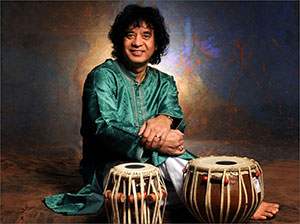
Zakir Hussain was one of the most consequential musicians of the modern era, celebrated for elevating the tabla from a supporting role in Indian classical music to a commanding global solo instrument. Deeply respected by traditionalists and innovators alike, he embodied a rare synthesis of rigorous classical discipline and expansive artistic vision. Through his performances on the world’s foremost stages, he emerged as a cultural ambassador who brought the sophistication of Indian rhythm into global musical consciousness.
Trained from early childhood within the guru–shishya parampara, Zakir Hussain inherited a profound rhythmic legacy while forging a voice that was unmistakably his own. His artistry was defined by technical mastery, emotional intelligence, and an exceptional ability to communicate complex rhythmic ideas with clarity and immediacy. Whether accompanying classical soloists or engaging unfamiliar audiences, he made intricate rhythmic structures intelligible and interesting across cultural boundaries.
What ultimately set Zakir Hussain apart was his ability to bridge musical worlds without compromising tradition. Rooted in Hindustani classical music yet fluent in jazz, world music, and cross-cultural collaboration, he helped shape the modern world-music movement and expand the expressive possibilities of percussion. As a performer, composer, educator, and mentor, his influence extended far beyond the stage. His legacy endures through his recordings, his students, and the global dialogue he fostered affirming rhythm as a universal language shaped by one extraordinary life.
Zakir Hussain Profile Summary
| Category | Details |
|---|---|
| Full Name | Zakir Hussain |
| Date of Birth | 9 March 1951 |
| Place of Birth | Mumbai (then Bombay), Maharashtra, India |
| Date of Death | 15 December 2024 |
| Place of Death | San Francisco, California, United States |
| Nationality | Indian |
| Profession | Tabla virtuoso, percussionist, composer, educator |
| Musical Tradition | Hindustani Classical Music (Punjab gharana) |
| Father | Ustad Alla Rakha (legendary tabla maestro) |
| Training | Guru–shishya parampara under Ustad Alla Rakha |
| Known For | Elevating the tabla as a global solo instrument; cross-cultural musical collaboration |
| Major Collaborations | Shakti, Planet Drum, global jazz and world-music artists |
| Film Work | In Custody, Little Buddha, and other film and multimedia projects |
| Awards | Padma Shri, Padma Bhushan, Padma Vibhushan, Multiple Grammy Awards, Sangeet Natak Akademi Award & Fellowship |
| Spouse | Antonia Minnecola (Kathak dancer and manager) |
| Children | Two daughters |
| Cause of Death | Idiopathic pulmonary fibrosis |
| https://www.instagram.com/zakirhq9/ |
Zakir Hussain Early Life and Background
Zakir Hussain was born on 9 March 1951 in Mumbai, India, into a household where Hindustani classical music formed the fabric of daily life. From infancy, he was immersed in an environment defined by rigorous practice, visiting musicians, and constant engagement with rhythm. Music was not introduced to him as a profession to be chosen later, but as a living tradition that shaped his earliest experiences.
As the eldest son of Ustad Alla Rakha, one of the most influential tabla players of the twentieth century, Zakir Hussain inherited a formidable legacy and standards. Alla Rakha’s global stature particularly through his long association with Ravi Shankar placed Zakir at the center of a tradition already engaged with international audiences. More importantly, his father instilled in him a philosophy that combined uncompromising discipline with openness to artistic dialogue, principles that later defined his own career.
From early childhood, Zakir Hussain absorbed music organically through constant exposure to complex rhythmic cycles, compositions, and improvisational exchanges. His formal training began at a very young age under the traditional guru–shishya parampara, emphasizing oral transmission, repetition, and total dedication. Long hours of practice, rhythmic recitation, and close supervision refined not only his technique but also his musical intuition and emotional maturity.
By the age of seven, Zakir Hussain was already performing publicly, and by his early teens he was touring internationally with senior musicians. These early experiences, combined with his upbringing in cosmopolitan Mumbai, gave him a rare dual perspective: deep grounding in classical tradition and early awareness of music as a global language. Together, lineage, discipline, early exposure, and cultural openness formed the foundation upon which his extraordinary musical life would be built.
Zakir Hussain Education and Musical Training
Zakir Hussain received his musical education through the guru–shishya parampara, one of the most rigorous and revered systems in Indian classical music. From early childhood, this immersive master–disciple tradition shaped not only his technical command of the tabla but also his philosophical understanding of rhythm as a living, evolving language. The emphasis on total dedication, oral transmission, and lifelong discipline laid the intellectual and artistic foundation for his future greatness.
His principal guru was his father, Ustad Alla Rakha, whose towering stature in the world of Indian classical music imposed exceptionally high standards. Training under such a master was uncompromising and exhaustive, demanding precision, tonal clarity, rhythmic balance, and deep structural understanding. Learning took place primarily through listening, vocal recitation of rhythmic syllables, and internalization of complex cycles before performance, cultivating extraordinary memory, analytical depth, and improvisational fluency.
Daily life during his formative years revolved around intense practice, preparation, and constant exposure to senior musicians. This environment instilled professionalism and artistic responsibility at an unusually young age. Crucially, his training prioritized musicality over mere virtuosity, emphasizing sensitivity, dialogue, and responsiveness to melodic instruments qualities that later distinguished him as one of the most empathetic and versatile accompanists and soloists in the tradition.
Alongside this classical training, Zakir Hussain pursued formal education in Mumbai, attending St. Michael’s High School and St. Xavier’s College. This academic grounding broadened his intellectual outlook and introduced him to Western music and ideas, which he explored with curiosity rather than imitation. His early exposure to jazz, rock, and Western percussion expanded his rhythmic vocabulary without weakening his classical roots, producing a rare balance of traditional authority and global awareness that would define his international career.
Zakir Hussain Rise as a Tabla Prodigy
Zakir Hussain emerged as a tabla prodigy at an exceptionally young age, distinguishing himself within India’s demanding classical music landscape well before adolescence. By the age of seven, he was already performing publicly alongside established musicians, displaying technical precision, rhythmic intelligence, and an uncommon composure on stage. These early performances revealed not merely precocious talent, but a deep musical sensibility that allowed him to engage rhythm as an expressive, dialogic force rather than a mechanical function.
His abilities quickly earned recognition from senior figures in Indian classical music, many of whom sought him out as an accompanist an extraordinary distinction for someone so young. Critics and audiences alike remarked on the maturity, balance, and imagination of his playing, noting that his musicianship suggested the arrival of a new generation rooted firmly in tradition yet capable of fresh interpretation. This early acclaim carried significant responsibility, accelerating his artistic development through constant exposure to high-level performance environments.
A defining element of his rise was early international touring, particularly in Europe and North America, where he encountered audiences unfamiliar with Indian classical music. These experiences honed his ability to communicate rhythm across cultural boundaries and helped him develop a distinct artistic identity separate from his father’s legacy. By the time he reached adulthood, Zakir Hussain had transitioned decisively from prodigy to professional, equipped with confidence, global perspective, and a personal voice that would soon propel him to international prominence.
Zakir Hussain Musical Style and Innovations
Zakir Hussain developed a musical style that combined uncompromising classical authority with an exceptional capacity for innovation. Firmly rooted in the Punjab gharana tradition, his playing was distinguished by power, tonal clarity, rhythmic precision, and balance. Rather than treating tradition as static, he approached it as a living system one that allowed interpretation, expansion, and personal expression while preserving structural integrity.
A defining feature of his artistry was his conversational approach to rhythm. Zakir Hussain transformed tabla accompaniment into active musical dialogue, responding intuitively to melodic lines with sensitivity, wit, and emotional intelligence. His mastery of improvisation enabled him to navigate complex rhythmic cycles with mathematical precision while maintaining narrative flow, allowing his solos to unfold with clarity and expressive purpose even for listeners unfamiliar with Indian rhythmic theory.
Perhaps his most enduring innovation was redefining the tabla as a fully realized solo and lead instrument. Through sustained solo performances and global collaborations, he demonstrated that rhythm alone could convey depth, tension, humor, and introspection. Informed by exposure to jazz, Western classical music, and global percussion traditions, his style remained authentically classical while embracing cross-cultural influence. This balance between reverence for tradition and openness to the contemporary world set a lasting standard for how classical musicians can evolve without losing their roots.
Zakir Hussain Global Career and Collaborations
Zakir Hussain built one of the most influential global careers ever achieved by an Indian classical musician, playing a decisive role in bringing Indian rhythm into mainstream international consciousness. At a time when Indian classical music was often perceived as specialized or peripheral outside South Asia, he emerged as a central figure who reframed the tabla as a universal instrument. His work did not merely expose new audiences to Indian music; it fundamentally altered how rhythm was understood across cultures.
His international recognition began early, through overseas tours during his teenage years, where he performed for audiences largely unfamiliar with Indian rhythmic traditions. These experiences revealed his exceptional ability to communicate complex musical ideas with clarity, charisma, and emotional immediacy. By the late 1960s and early 1970s, he was already recognized in Western musical circles as far more than an accompanist, attracting the attention of prominent musicians, producers, and composers.
A defining milestone in his global career was the formation of Shakti with guitarist John McLaughlin, a project that helped establish the foundations of modern musical fusion. Unlike surface-level crossovers, Shakti was built on rigorous musical understanding and mutual respect, with Zakir Hussain’s rhythmic intelligence serving as its structural anchor. The group demonstrated that Indian classical rhythm and jazz improvisation could coexist organically, leaving a lasting impact on the evolution of world music.
Beyond Shakti, Zakir Hussain collaborated widely across genres, working with jazz artists, Western classical ensembles, percussion collectives, and experimental composers. Living and working extensively in the United States while remaining deeply connected to India, he functioned as a continuous bridge between musical traditions. By the later stages of his career, he was recognized not simply as an Indian musician performing globally, but as a truly global artist. In redefining what an Indian classical musician could be in the modern world, he set a lasting standard for authenticity, depth, and cross-cultural respect that continues to shape global music today.
Zakir Hussain Film Music and Other Creative Works
Zakir Hussain extended his artistic influence far beyond the concert stage through significant work in film, theatre, and multimedia projects. In these contexts, he treated rhythm not as a decorative element but as a central narrative force, capable of shaping emotion, pacing, and atmosphere. His engagement with visual storytelling allowed him to apply the depth of Indian classical rhythm to new formats while retaining its expressive integrity.
In film music, Zakir Hussain developed an approach distinct from conventional background scoring. His contributions to works such as In Custody and Little Buddha integrated classical rhythmic principles with orchestral and ambient textures, demonstrating how sophisticated rhythmic structures could function seamlessly within cinematic language. These projects showcased his ability to translate the subtlety and complexity of Indian rhythm into forms accessible to international audiences without diminishing artistic depth.
Beyond cinema, his involvement in theatre, dance, and conceptual multimedia projects reflected a broader compositional vision. He collaborated on rhythm-centered ensembles, interdisciplinary performances, and educational formats that blurred the line between concert and exploration. Increasingly recognized as a composer rather than solely a virtuoso instrumentalist, Zakir Hussain brought coherence, structure, and philosophical continuity to every medium he touched. Through this work, he embedded rhythm as a universal expressive language across artistic forms, ensuring his influence resonated well beyond traditional performance spaces.
Zakir Hussain Awards and Achievements
Zakir Hussain received an extraordinary range of honors over a career spanning more than six decades, reflecting his stature as one of the most important musicians of his time. These awards recognized not only his unparalleled technical mastery of the tabla, but also his decisive role in reshaping the global perception of Indian classical music. Collectively, they document a life devoted to artistic excellence, cultural continuity, and international dialogue.
Within India, Zakir Hussain was among the rare artists to receive all three of the country’s highest civilian honors (Padma Shri, Padma Bhushan, and Padma Vibhushan) a distinction that underscored his national significance and enduring cultural impact. His recognition by the Sangeet Natak Akademi, including both the Akademi Award and the prestigious Fellowship, affirmed his authority within the classical tradition itself. These honors acknowledged not only performance brilliance, but also scholarship, discipline, and his contribution to sustaining and advancing Indian music.
Internationally, Zakir Hussain achieved rare success for an Indian classical musician, earning multiple Grammy Awards and numerous global honors for collaborative world-music projects. These accolades positioned Indian percussion at the center of global musical discourse and highlighted rhythm as a universal artistic language. Yet, despite this extensive recognition, he consistently viewed awards as responsibilities rather than personal triumphs. Taken together, his achievements stand as formal confirmation of a legacy that continues to shape musicians, institutions, and audiences worldwide, long after his passing.
Zakir Hussain Personal Life, Marriage and Children
Zakir Hussain maintained a personal life characterized by discretion, balance, and quiet discipline, even as his professional commitments placed him at the center of the global music world. Those who worked closely with him consistently described him as thoughtful, grounded, and reflective, with a warmth and humility that contrasted with his towering artistic stature. These personal qualities closely mirrored his musical approach of being precise, sensitive, and deeply attentive to others.
Central to his personal life was his marriage to Antonia Minnecola, a trained Kathak dancer who also served as his longtime manager. Their relationship functioned as both an artistic and professional partnership, built on shared cultural understanding and mutual trust. Minnecola played a key role in managing his international career, enabling him to sustain an intense global schedule while remaining focused on creative excellence. Together, they navigated the demands of international recognition without losing connection to classical tradition.
Family and continuity held lasting importance for Zakir Hussain. As a father of two daughters, he valued the transmission of discipline, curiosity, and artistic integrity across generations, reflecting the lineage-based values of his own upbringing. Although he lived and worked extensively in the United States, he maintained strong ties to India and consistently affirmed his grounding in Indian classical culture. His commitment to mentorship and education further underscored a life guided by responsibility rather than celebrity. Ultimately, his personal life provided the stability and perspective that sustained his long career, reinforcing his reputation not only as a master musician, but as a deeply respected human presence in the world of music.
Zakir Hussain Health, Final Years, and Death
Zakir Hussain remained a deeply respected and active figure in the global music community during the final years of his life, even as serious health challenges began to limit his public engagements. Diagnosed with idiopathic pulmonary fibrosis, a chronic and progressive lung disease, he gradually reduced extensive international travel and large-scale touring. Nevertheless, his commitment to music never wavered; when he did appear on stage, his performances were marked by exceptional clarity, emotional depth, and artistic dignity, resonating powerfully with audiences aware of his declining health.
As his physical stamina decreased, Zakir Hussain became increasingly selective in his Stage performance choices. He focused on meaningful collaborations with long-standing musical partners, special festival appearances, and educational initiatives rather than frequent performances. A growing emphasis on mentorship defined this period, as he devoted substantial energy to teaching, masterclasses, and guiding younger musicians. This shift reflected a deliberate effort to safeguard the continuity of the rhythmic traditions he had spent a lifetime mastering and expanding, ensuring that his knowledge would endure beyond his own performances.
Zakir Hussain passed away on 15 December 2024 in San Francisco at the age of seventy-three (73), prompting a global outpouring of tributes from musicians, institutions, and audiences across genres and continents. His death was widely regarded as the close of a historic chapter in Indian classical and world music. Memorial concerts and written tributes underscored not only the magnitude of his artistic contributions but also the human qualities that defined him which are grace, generosity, discipline, and humility. While his physical presence has ended, his legacy continues to resonate through recordings, students, and the global musical dialogue he helped shape, affirming his enduring place in cultural history.
Zakir Hussain Legacy and Cultural Impact
Zakir Hussain is remembered as a transformative force whose impact extended far beyond virtuosity. He fundamentally reshaped the role of rhythm in Indian classical music and global performance, establishing the tabla as a solo and lead instrument capable of sustaining narrative, emotional depth, and intellectual rigor. By doing so, he altered long-standing assumptions about percussion, influencing concert formats, pedagogy, and audience expectations within the classical tradition.
Equally significant was his role in globalizing Indian rhythmic systems without diluting their complexity. Zakir Hussain introduced international audiences to Indian classical rhythm through clarity, expressiveness, and collaboration, positioning rhythm as a universal point of musical entry. His cross-cultural work set a gold standard for artistic fusion—one rooted in mutual respect, deep listening, and structural integrity rather than surface-level blending. As a result, his influence is evident across world music, jazz, and contemporary intercultural projects worldwide.
Beyond performance, Zakir Hussain’s legacy is sustained through teaching, mentorship, and cultural leadership. He shaped generations of musicians by emphasizing humility, individuality, and thoughtful evolution within tradition. As a cultural ambassador, he embodied continuity between past and future, tradition and innovation, India and the world. Though no longer physically present, his influence remains active through recordings, students, and ongoing artistic practices, affirming his enduring role as a guiding pulse in global music and a symbol of rhythm as a shared human language.
Conclusion
The life and work of Zakir Hussain exemplify a rare union of inherited tradition and transformative vision. Trained from childhood in the rigorous discipline of Indian classical music, he honored the lineage he came from while continually extending its expressive and cultural reach. His career reflects both continuity and evolution, marking him as a musician who preserved the core of his tradition even as he reshaped its global presence.
Zakir Hussain’s enduring significance lies in his ability to make rhythm a shared, cross-cultural language. Through performance, collaboration, education, and composition, he demonstrated that classical traditions can engage meaningfully with the modern world without losing their essence. Although his passing in 2024 closed a remarkable chapter, his influence remains active through recordings, students, and artistic ideals that continue to guide musicians worldwide. His legacy stands as a testament to music’s power to connect generations, cultures, and continents through a single, disciplined, and visionary life.
Frequently Asked Questions About Zakir Hussain
- Who was Zakir Hussain?
Zakir Hussain was one of the most influential tabla players in history, globally recognized for elevating Indian classical rhythm to the international stage through performance, collaboration, composition, and education.
- When and where was Zakir Hussain born?
He was born on 9 March 1951 in Mumbai (then Bombay), India.
- Is Zakir Hussain alive?
No. Zakir Hussain passed away on 15 December 2024.
- When did Zakir Hussain die?
He died in December 2024 in San Francisco, California, at the age of 73.
- What was the cause of Zakir Hussain’s death?
Public reports state that he was suffering from idiopathic pulmonary fibrosis, a chronic lung disease.
- Who was Zakir Hussain’s father?
His father was Ustad Alla Rakha, one of the most celebrated tabla maestros of the 20th century and a key figure in bringing Indian classical music to global audiences.
- How did Zakir Hussain learn tabla?
He was trained from early childhood under the guru–shishya parampara, receiving rigorous instruction from his father through oral tradition, intensive practice, and lifelong discipline.
- What musical tradition did Zakir Hussain belong to?
He was primarily associated with the Punjab gharana of tabla playing, known for power, clarity, and rhythmic complexity.
- Why is Zakir Hussain considered so important?
He redefined the tabla as a solo and lead instrument, globalized Indian rhythmic systems, and set a benchmark for authentic cross-cultural musical collaboration.
- Did Zakir Hussain collaborate with Western musicians?
Yes. He collaborated extensively with international artists across jazz, classical, and world music, playing a central role in the global fusion movement.
- What was Shakti?
Shakti was a pioneering Indo-jazz fusion ensemble co-founded by Zakir Hussain and guitarist John McLaughlin, widely regarded as foundational to modern world music.
- Did Zakir Hussain work in films?
Yes. He composed and performed music for Indian and international films, including In Custody and Little Buddha, treating rhythm as a narrative and emotional force.
- What awards did Zakir Hussain receive?
He received:
- Padma Shri
- Padma Bhushan
- Padma Vibhushan
- Multiple Grammy Awards
- Sangeet Natak Akademi Award and Fellowship
- Was Zakir Hussain Indian or American?
He was Indian by nationality. Although he lived and worked extensively in the United States, he remained culturally and artistically rooted in Indian classical tradition.
- Who was Zakir Hussain’s wife?
He was married to Antonia Minnecola, a Kathak dancer who also served as his longtime manager.
- Did Zakir Hussain have children?
Yes. He had two daughters, both involved in creative fields.
- What is Zakir Hussain’s legacy?
His legacy lies in transforming global perceptions of rhythm, mentoring generations of musicians, and establishing Indian classical music as a vital force in contemporary world culture.
Read more:
Be the first to comment